

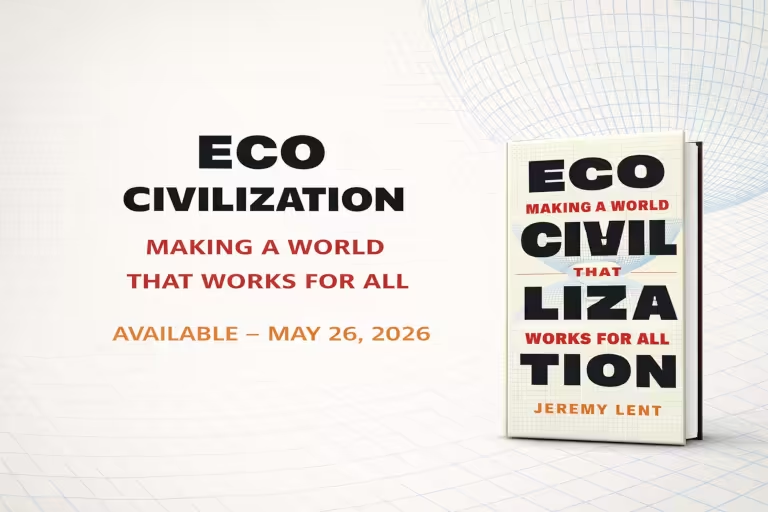
[Modified excerpt from the Introduction of Ecocivilization: Making a World that Works for All, to be published by Melville House on May 26].
The case for reimagining civilization from the ground up
Few people have had as much effect on the recent direction of the world as Tina. In virtually every major policy decision in just about every country on the planet, Tina has been the one to shape the debate — telling people what they can, and can’t, talk about.
How come you’ve never heard of Tina? Because Tina isn’t a person, but an idea. Or perhaps more accurately, a killer of ideas. TINA is the acronym of Margaret Thatcher’s famous 1980 declaration: “There Is No Alternative.” With those four words, Thatcher signaled an unyielding assault on the delicate balance between government and private enterprise that had evolved in Great Britain since the end of the Second World War.
TINA’s creed did not stop at Britain’s shores. Following the ascendancy of Ronald Reagan to the presidency of the United States, the two leaders unleashed onto the world an ideology that had been incubating for decades. That ideology — generally referred to nowadays as neoliberalism — holds that humans are individualistic, selfish, calculating materialists, and that because of this, unrestrained free-market capitalism provides the best framework for every kind of human activity. It has since become the de facto governing doctrine of virtually every aspect of human endeavor, infiltrating its core beliefs into politics, finance, culture, education, technology, and agriculture.
A decade after neoliberalism took hold, the Berlin Wall fell. Capitalism had won the Cold War. One triumphant commentator infamously proclaimed it “the end of history.” There was no longer any alternative. Game over. TINA now reigned supreme.
Since that time, neoliberal adherents have transformed the world into a gladiatorial arena where markets are the ruling force of human activity. Regulations have been shredded across the globe. Billions are malnourished while mega-billionaires vie for planetary domination. Profit-seeking corporations have surpassed nation states in economic power. Animal populations have been decimated. And each year brings our civilization closer to the cataclysm of climate breakdown.
People increasingly intuit that the system is not working for them. Angry and desperate, they turn to the only voices that seem to recognize their plight — extremist authoritarians promising to dismantle the structures that have immiserated them. Yet even those genuinely concerned about the state of the world still organize their activities around the unquestioning acceptance of TINA. Virtually all serious policy proposals work within the framework of the current system rather than examining the system itself.
It is time to dethrone TINA. There is, in fact, an alternative.
A Faulty Operating System
That alternative is not the kind that Thatcher and Reagan spent their careers railing against. Throughout the twentieth century, the choice was always between capitalism and socialism — between the market and the state — closing off any other possibility. Yet these opposing sides shared more than they acknowledged. Both prized ideology over the dignity of ordinary lives. Both worshipped economic growth as the supreme aspiration of policymaking. And both viewed the entire Earth as nothing more than a resource to exploit in the pursuit of that growth.
This pursuit of endless growth on a finite planet has propelled us onto a terrifying trajectory. Our civilization is already running at forty percent above its sustainable capacity. Animal populations worldwide have declined by seventy-three percent since 1970. Climate scientists warn that current policies put us on track for three degrees of heating by century’s end — with amplifying feedbacks potentially making things far worse. In 2017, over fifteen thousand scientists from 184 countries issued a stark warning: “Soon it will be too late to shift course away from our failing trajectory.”
Rather than shifting course, though, we have kept going pedal to the metal. The growth imperative underlying this juggernaut is built into the very fabric of our global economic system. Even in the face of this despoliation of the living Earth, global production and consumption levels are projected to more than double by 2060. Yet there is virtually no mainstream discussion of the system itself — only proposals that tinker at details within it.
We can think of our civilization like a faulty operating system with multiple bugs. Each time the engineers fix one bug, it complicates the code, producing new bugs requiring more heroic workarounds. Ultimately, someone has to be willing to say: the problem isn’t just the software — an entirely new operating system is required.
It doesn’t take a PhD in economics to see this. It just takes the courage of a fifteen-year-old like Greta Thunberg, who told world leaders at a UN Climate Conference: “If solutions within this system are so impossible to find, maybe we should change the system itself.”
A Civilization Based on Life’s Design Principles
What would it actually mean to change the operating system? Around the world, activists, scholars, and community organizers are already laying down pathways toward a life-affirming future — driven by shared imperatives to care for others, nurture the living Earth, and leave a healthy world for future generations. Increasingly, people are giving a name to this burgeoning global movement: a transition toward an ecological civilization.
An ecological civilization — or “ecocivilization” — takes its inspiration from the principles of life itself. Without human disruption, ecosystems thrive in rich abundance for millions of years, remaining resilient in the face of adversity. A central principle of life is mutually beneficial symbiosis: the process by which both parties in a relationship give and take reciprocally. There is no zero-sum game here — the contributions of each party create a whole greater than the sum of its parts. The pursuit of symbiosis naturally leads away from extractive and exploitative behaviors and toward life-enhancing practices throughout society.
Ecologies are fractal in structure — tiny cells nested within organisms, nested within populations, nested within ecosystems, nested within the living Earth. In all cases, the long-term health of the larger system requires the flourishing of each of its parts. This principle of fractal flourishing inspires the ultimate objective of an ecocivilization: to create the conditions where each person’s flourishing naturally contributes to the greater wellbeing of the systems in which we are all embedded.
Such a civilization would also align with what humans have evolved to need in order to flourish. We did not evolve to find happiness in taking orders from a boss, eating fast food stuck in traffic, or gazing for hours at a screen. We spent ninety-five percent of our species’ history in nomadic hunter-gatherer bands, where welfare depended on how well we got along with those around us. Over thousands of generations, we evolved to become a highly cooperative species, thriving in egalitarian communities that valued fairness and generosity. Core principles of an ecocivilization arising from our evolutionary heritage include qualities that most of us continue to prize, such as justice, respect for others, mutuality, and dignity, along with a sense of belonging both within our community and as part of the living Earth.
Let’s Get Realistic
A reasonable person might say: this is so far from our present reality that there seems little point in considering it. Let’s get realistic.
There are two ways to think about “realistic.” One way is to begin with what is happening now and try to improve things incrementally — use fewer fossil fuels, advocate for higher taxes on the wealthy. But when the situation keeps getting worse in spite of our best efforts, it is unrealistic to believe that more of the same will produce different results. It makes no sense to believe that we can continue to get away with infinite growth on a finite planet, and yet that’s what passes for realistic in today’s mainstream discourse.
The other way to think about “realistic” is to sketch out the conditions that might allow human civilization to prosper into the indefinite future, then work toward those conditions. Planners call this backcasting. By focusing attention on a genuinely desirable future and working backward, we avoid constraining our imagination to the narrow parameters of what appears possible from where we now stand.
This is what Greta Thunberg was pointing to when she declared: “Until you start focusing on what needs to be done rather than what is politically possible, there is no hope.”
Thinking beyond the TINA-constrained options of our daily news feed, we find remarkable possibilities. Societal institutions we take for granted as naturally ordained — law, money, education — were designed from the outset to reinforce the power of wealthy elites, and can be redesigned for the benefit of us all. Advanced technology can be reconfigured to empower ordinary people rather than mega-corporations. Cities can be redesigned to promote wellbeing rather than consumerism. Democracy can be reconceived so that regular citizens, rather than wealthy oligarchs, thoughtfully determine the best policies for society. Corporations can be legally restructured to work for people and the planet rather than merely for profit. Enforceable Rights of Nature legislation can look out for the welfare of the other sentient beings with whom we share this world.
This is not “hopium” — assuring you that everything will somehow turn out fine. The gap between the beckoning future of an ecocivilization and today’s grim reality is only too clear. But to the extent that meaningful hope does arise, it emerges from the very ruptures of our present breakdown. As the weave of our dominant system unravels, possibilities emerge to reweave our societal fabric into a new design.
The systems thinker Ilya Prigogine described how complex systems transition from one stable state to another. At first, things look very messy — like the mush inside a cocoon, the dissolved flesh of a caterpillar preparing to become something else entirely. But within the mess, inklings appear of a new stable state into which the system might transform. Prigogine called these “small islands of coherence in a sea of chaos” which had “the capacity to lift the entire system to a higher order.”
Those islands exist today. Whether they can rise high enough to combine and form a new landmass will only be known on the other side of the turmoil ahead. But if we can map them out, and join with others in weaving them together, we just might lay the groundwork for a new chapter in humanity’s story — an ecocivilization where humans and our nonhuman relatives can flourish together into the indefinite future.
That project begins with a simple but radical act of imagination: believing that there is, in fact, an alternative.
Ecocivilization: Making a World that Works for All
Melville House: available May 26, 2026
PREORDER: Bookshop.org | Amazon US | Amazon UK




Comments
Welcome to the new Resillience commenting system!
We have moved from the former Disqus commenting system to a new system as of September 10, 2026.
We made this change because of privacy concerns regarding Disqus. It's also part of a set of changes to bring more services to the Resilience community under a single login: commenting, (coming September 2026), and online courses (coming 2027). Unfortunately, your old Disqus comments may not reliably link to your account in this new system. Please contact us if you have any questions or concerns.