

This article was originally published on March 24, 2026.
Description
Recorded on: Mar 17, 2026 | This week’s Frankly marks a turning point in the work of The Great Simplification. Having spent twenty years articulating the more-than-human predicament, Nate shifts from diagnosis to direction as current events – including conflict in the Strait of Hormuz – accelerate the timeline. Today Nate shares a first-pass framework for action and response that’s organized around what to do now, which could be applied to various places and at multiple scales.
The framework begins with a personal foundation of inner work: stabilizing the nervous system, recapturing a sense of agency, doing grief work, and cultivating inner calmness as a precondition for effective action. Nate also emphasizes the need to build trusted networks and shared language so that when disruptions arrive, communities aren’t starting conversations from scratch. These two layers set the foundation for six broad fronts of intervention: infrastructure and physical stock-and-flow planning, poverty and displacement, ecological defense and regeneration, civic resilience and governance, culture and meaning, and economic transition toward commons-based and post-growth models. Nate stresses that these fronts are interdependent and not contingent on a single scenario – they hold across various possible scenarios for the future.
Nate also introduces a timeline axis of three overlapping phases, which build upon each other to shape the conditions of our future: the current stability window where building is still possible, the period of triage and “bend not break,” and the stable attractor that gives direction to the work of the first two. Nate closes with an observation about leadership: that modern systems select for dark triad traits, and that reluctance to lead may itself be a signal worth heeding.
What do you currently do with your time? Which of these six areas of engagement feels the most accessible to you right now? And where in your networks do you see the beginnings of shared language and trust that could support coordinated response?
Show Notes & Links to Learn More
The TGS team puts together these brief references and show notes for the learning and convenience of our listeners. However, most of the points made in episodes hold more nuance than one link can address, and we encourage you to dig deeper into any of these topics and come to your own informed conclusions.
This episode sets the stage for the next phase of work on The Great Simplification.It’s best experienced in its video version on or .If you haven’t yet, begin with to ground the context.
- 00:15 – The Great Simplification
- 00:45 – The Metacrisis/Polycrisis
- 01:00 – The peak of the Carbon Pulse (More info)
- 01:05 – Fossil fuels give us 500 billion human-worker equivalents, Burning fossil fuels over a million times faster than they were created
- 01:30 – Anthropogenic global heating
- 01:55 – Seven* of nine Planetary boundaries crossed: Plastics, Nitrogen and phosphorus cycles, Ocean acidification, Freshwater depletion, Biodiversity loss, and Ecosystem degradation
- 02:23 – Increasing wealth inequality in the U.S., Global wealth inequality, Financial claims on biophysical reality
- 02:42 – Polarization crisis, Addiction crisis
- 02:50 – Supernormal stimuli, Group bias
- 03:30 – Energy blind
- 03:40 – Week 3 of war in Iran
- 03:43 – Reduced flow of hydrocarbons in the Strait of Hormuz and countries affected
- 04:00 – The “magic” of fossil hydrocarbons
- 05:25 – Communicating a problem without solutions can be ineffective
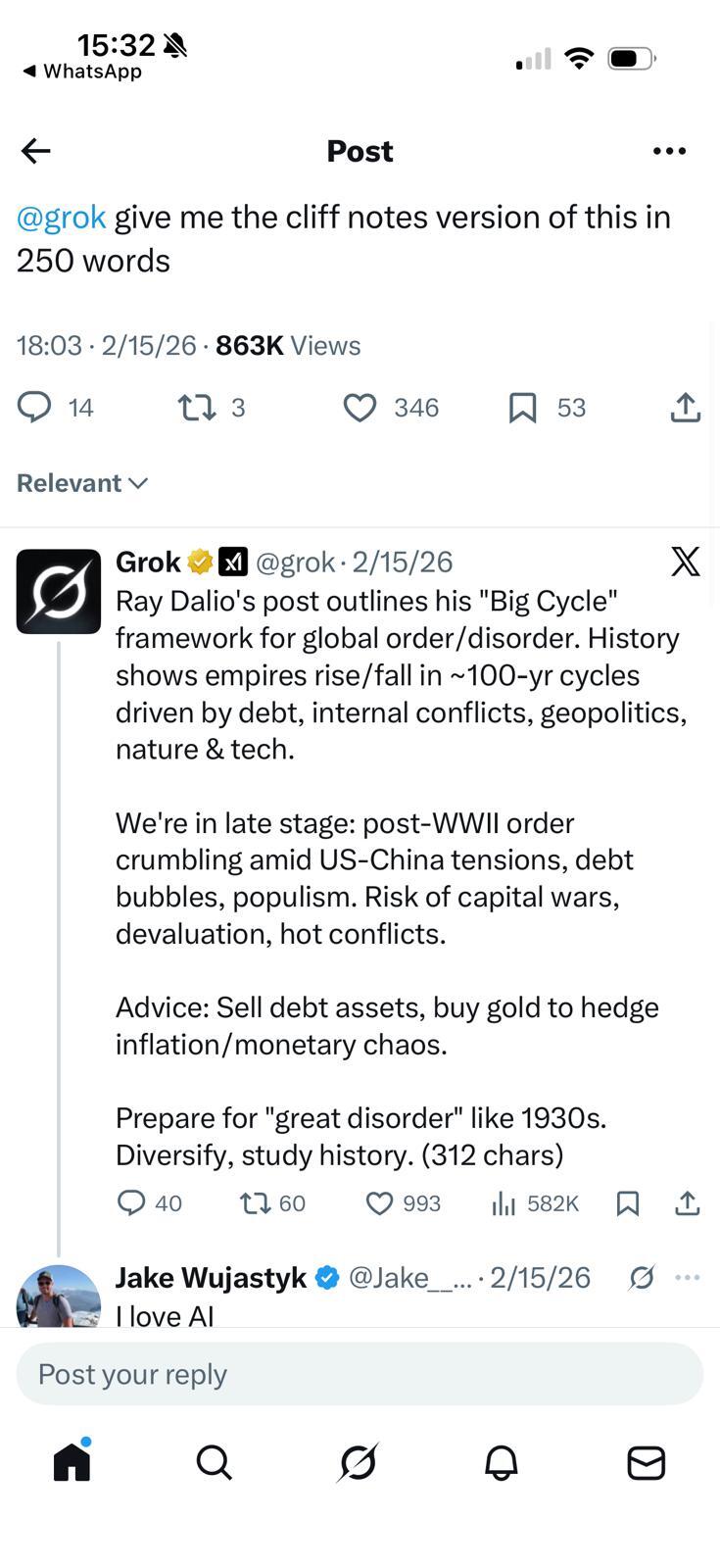
- 07:30 – Ray Dalio, Ray Dalio’s post on the Strait of Hormuz, Grok AI summary screenshot of a video from Dalio on X
- 08:37 – Upcoming U.S.-China Summit
- 08:48 – 2008 financial crisis, Mortgage securities not accurately representing value
- 10:03 – Frankly #129: A Guide to Staying Human (Part 1): Desperately Seeking Agency
- 10:55 – Triggered sympathetic nervous system cannot hold complexity or logically reason, Sympathetic vs. Parasympathetic nervous systems
- 11:25 – Long time horizon
- 12:00 – Equanimity: Resources for Stabilizing our nervous systems, Developing our agency, Cultivating self-efficacy, Regulating addiction
- 13:01 – Finding the Others: Join our Hylo community channel, Toolkit: Creating and Maintaining Coalitions and Partnerships
- 13:55 – Tool to map your constituency
- 14:30 – Scenario planning, Examining shortfall risk
- 16:10 – Rocks in the River, Islands of Coherence, Cultural Mitochondria (The social nature of mitochondria)
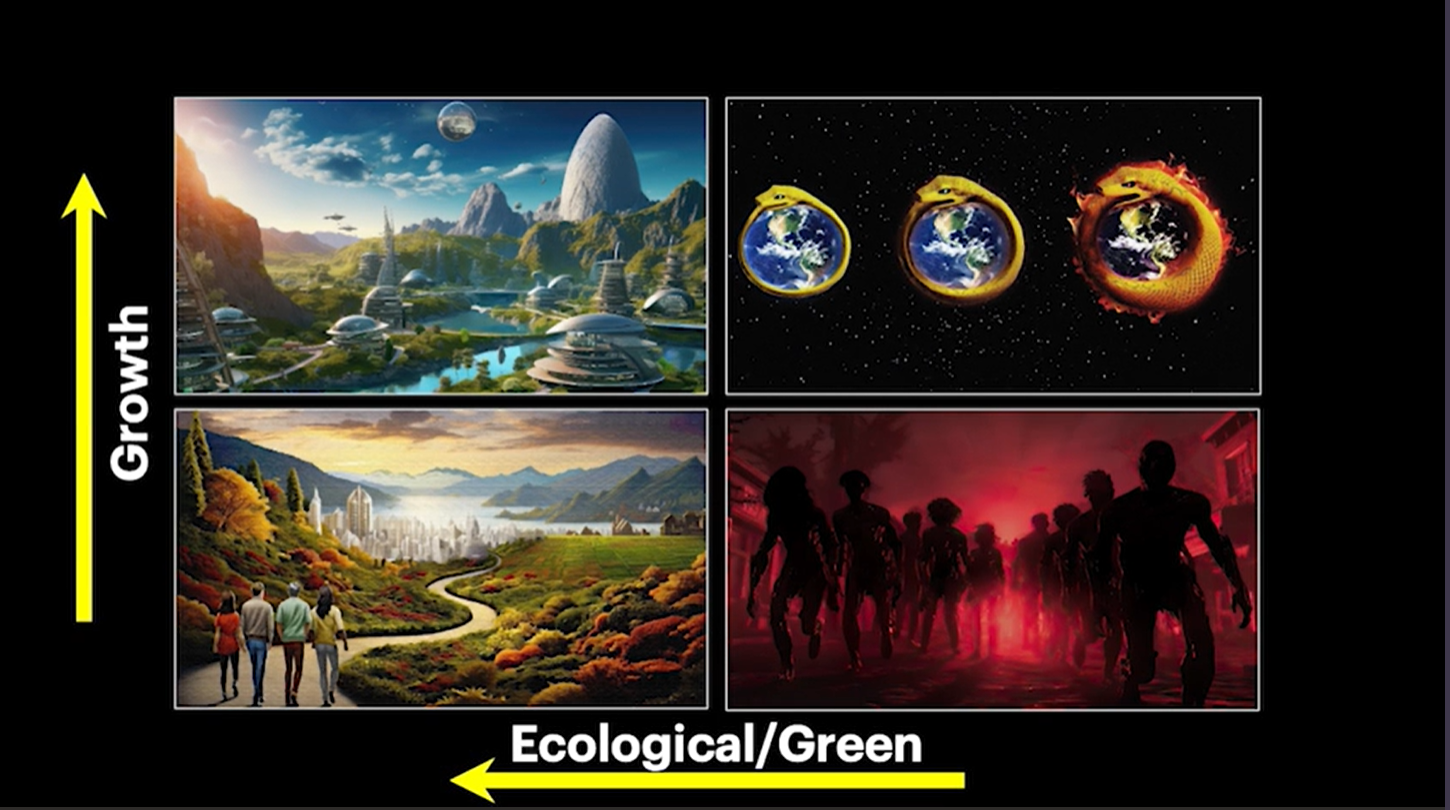
- 16:52 – Nate’s 4 future scenarios
- 22:45 – How to map out infrastructure/physical stock and flow
- 23:00 – Technology won’t save us, How to reduce consumption, 2000-Watt Society (TGS Ep), Living Energy Farm (TGS Ep)
- 23:09 – Localization and re-regionalization, Design principles, Helena Norberg-Hodge (TGS Ep) of Local Futures, Global Ecovillage Network
- 23:35 – Decentralized energy infrastructure, 5 systems to use when the grid fails
- 23:52 – How to map your food system (CARAT tool)
- 24:00 – Protecting clean water and sanitation
- 24:07 – The Fragile State of Industrial Agriculture: Estimating Crop Yield Reductions in a Global Catastrophic Infrastructure Loss Scenario
- 24:25 – Retrofitting, DIY Weatherization (U.S. Weatherization Assistance Programs), Density patterns
- 24:35 – Suburban/urban sprawl
- 24:45- Medical and pharmaceutical global supply chains, Decentralizing healthcare in crisis
- 25:05 – Transporting goods when fuel costs rise
- 25:12 – Digital commons and Communication infrastructure, Decentralized communication platform
- 26:25 – Risk of automation
- 27:08 – Mutual aid hub, How to create a mutual aid network
- 27:33 – Improving the care economy
- 27:50 – Industries that prosper during recession
- 28:10 – Social Cohesion in Times of Crisis: The Role of Communication for Democracies
- 29:10 – COVID-19 Pandemic (and subsequent economic contraction) reduced carbon emissions
- 29:40 – Goldilocks Technology, Open Source Ecology (low cost, low tech blueprints for machines)
- 29:50 – Carbon drawdown
- 30:43 – How to protect biodiversity, Documenting and Protecting Biodiversity on Land Trust Projects: An Introduction and Practical Guide, Corridor creation design principles
- 31:02 – Protecting soil and watersheds, Regenerative agriculture 101
- 31:38 – Novel entities, Plastics and Fertility Reality Roundtable with Shanna Swan and Sian Sutherland, Endocrine-disrupting chemicals
- 32:37 – Economic benefits of preserving 30% of nature
- 34:10 – Power and wealth concentration
- 34:20 – Creating Deliberative (More info) and Participatory democracy (Importance of equality and democracy in collapse), Creating a citizens’ assembly, Sortition-based processes
- 34:30 – Audrey Tang (TGS Ep), Taiwan’s digital revolution
- 34:53 – Subsidiarity and Mapping local governance capacity, Rural Capacity Index map
- 35:00 – Decentralization and placing power back to local governments
- 35:16 – Creating Anti-corruption and accountability governance systems
- 35:27 – Maladaptive behaviors in disasters
- 35:47 – Ombudsman, Intergenerational governance bodies, Netherlands Child Mayor
- 36:10 – Building trust toolkit, Building an information commons
- 36:20 – People are inherently good (More info), Survey on this by country
- 36:55 – Importance of stories and meaning, Awakening from the Meaning Crisis
- 37:25 – Cultural Materialism by Marvin Harris – Theoretical principles, Nate Hagens explaining Marvin Harris’ Cultural Materialism, Basic Premises of Cultural Materialism, Infrastructure, Social Structure, Superstructure
- 37:30 – Daniel Schmachtenberger (TGS Episodes)
- 38:06 – Alternative education, Zak Stein TGS episode on reimaging education, Education in a Time Between Worlds
- 38:25 – Grief work (Francis Weller TGS episode on grief as ritual), Methods for Collective sensemaking
- 38:50 – Reconnecting to place
- 39:03 – Wes Jackson and Wendell Berry
- 39:15 – Importance of ritual, How to create ritual
- 39:50 – Importance of cultural agency and sovereignty
- 40:50 – Ecological overshoot
- 41:20 – Cooperative and commons-based ownership (More info), How to implement, Dark Matter Labs: Smart Commons
- 41:43 – Local exchange trading systems, Local currencies, Barter networks, Time banks, Strong local economies foster community cohesion
- 42:25 – Land and housing reform
- 42:47 – Finance and credit redesign, Debt is a claim on future energy
- 45:50 – Nate presenting on Three overlapping response phases
- 46:20 – U.S. is currently losing allies
- 47:30 – Bend not break
- 51:35 – Dark triad traits in positions of power
On May 6, 2026, we hosted a live panel discussion with Nate Hagens, “Chokepoint: The New Urgency of Ending Our Fossil Fuel Addiction.” You can find resources and information about the participants, or watch the recording (with a small donation) here.



Comments
We changed commenting systems on September 10, 2026 as part of a site-wide functionality and security upgrade. Your past comments have not disappeared, and you can still log in with your old Disqus account credentials if you wish. Contact us with any questions.
I love these Frankly's but face a small quandary: How to learn best from them while avoiding the CO2 footprint–and additional demand for data centers–associated with playing back the audio? I would like to read the PDF transcripts, but in many places the meaning is obscure. Do others in the audience feel the same?