

Recorded on: Feb 4, 2026
Description
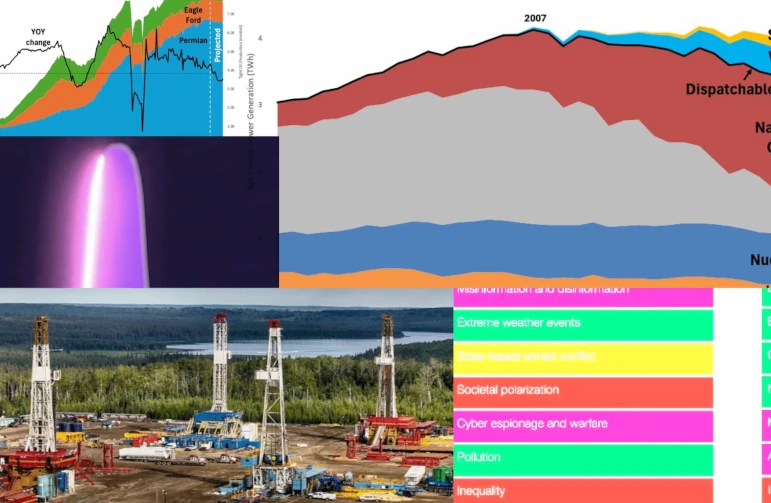
This week’s Frankly is another edition of Nate’s Wide Boundary News series, where he invites listeners to view the constant churn of headlines through a wider-boundary lens. Today’s edition features reflections on a new peak in crude oil production, the growth of non-dispatchable electricity, and a report recently released by the World Economic Forum assessing global risks. Nate ties each topic to the larger story of the Great Simplification, updating listeners on what pathways might be available to pursue the long-term stability of humanity in the biosphere.
What factors have contributed to the new peak in oil production? How does dispatchability play into the current electricity landscape? And when global experts outline the future risks facing our world, who do we call on for action today?
Show Notes & Links to Learn More
The TGS team puts together these brief references and show notes for the learning and convenience of our listeners. However, most of the points made in episodes hold more nuance than one link can address, and we encourage you to dig deeper into any of these topics and come to your own informed conclusions.
Link to reference key graphs used in this episode.
00:05 – Wide Boundary News Previous video, Wide-boundary perspective
00:30 – All-time high crude oil production late 2025, Peaks of Natural gas liquids and other lower BTU liquids
00:36 – Crude oil plus condensate (true oil) vs. Other liquids
00:57 – Mid-2020 oil price plunge
01:22 – Drilling and finding oil by using AI, OPEC crude oil production, Russia-Ukraine War
01:40 – Carbon Pulse
01:48 – U.S. oil production
01:52 – Biophysical gauntlet of oil production (see Frankly #121 Wide Boundary News 1/29/2026), Lower oil demand leads to less investment from oil producers
02:09 – Crude oil to fall below $60 per barrel
02:17 – Permian Basin, Permian Basin decline, Next great migration for shale gas and tight oil will be to the Montney and Duvernay shales in Alberta
02:43 – U.S. electricity price increasing faster than gasoline, heating oil, and natural gas
02:55 – Price of U.S. electricity
03:05 – Accelerating electricity demand from data centers
03:19 – U.S. dispatchable electricity has fallen, From Nate: “I’m using “dispatchable” as shorthand for reliable 24/7 capacity, i.e., not wind and solar. That’s not strictly what some would label as “baseload,” but my point is that grid reliability is what matters. Reliability is shrinking while demand is growing. More unpacking on this point in near future”
03:31 – Growth of solar and wind
04:22 – Wind and solar are variable
04:36 – Countries with wind and solar capacity are still dependent on natural gas
04:54 – The AI Race
05:40 – Blackouts, Brownouts, and frequency globally, U.S. Energy Department report raises blackout risks from AI infrastructure, Risk Area Summary 2026-2030
06:02 – “Rebuildables”, Renewable energy comprises only 20% of total energy use today
07:02 – Google shares decline after announcing budget increasing AI computing capacity
07:22 – AGI and ASI as international security issues
07:31 – Nationalization
08:10 – Davos 2026, World Economic Forum Global Risks Perception Survey 2024-25, Full report
- Results ranking Near-term risks and Long-term risks on Page 8 of Full report
08:32 – Extreme weather, Biodiversity loss, Ecosystem tipping points
08:41 – Aggregate human behavior, Mob mentality
08:58 – Polarization, (Spread of) misinformation
10:15 – J.R.R. Tolkien, Robin Hobb, Farseer trilogy
11:23 – Jeffrey Epstein, Epstein File Library
12:30 – Dark Triad and their ability to rise to power, TGS Reality Roundtable #19 Dark Triad





Comments
Welcome to the new Resillience commenting system!
We have moved from the former Disqus commenting system to a new system as of September 10, 2026.
We made this change because of privacy concerns regarding Disqus. It's also part of a set of changes to bring more services to the Resilience community under a single login: commenting, (coming September 2026), and online courses (coming 2027). Unfortunately, your old Disqus comments may not reliably link to your account in this new system. Please contact us if you have any questions or concerns.