


This is part of a series of posts representing ideas from the book, Ishmael, by Daniel Quinn. I view the ideas explored in Ishmael to be so important to the world that it seems everyone should have a chance to be exposed. I hope this treatment inspires you to read the original.
In the Foreword to the 25th anniversary printing, starting on page xxiv, Daniel Quinn offers seven pages of additional material that he suggests could be appended to what is already the longest chapter in the book. The audiobook I listened to rolls right into this material at the end of Chapter 9 without pausing to indicate that it was not in the original.
Rather than making the Chapter 9 post even longer than it already is, I decided to make a separate entry for this material (also inserted into the schedule so-as not to disrupt the normal cadence of two “real” chapters per week).
Unlike the original content, this addendum is not split into numbered sections. I create section headings all the same just to break things up a bit.
Population Surge
In the context of asking Alan what fate he imagined we faced, Ishmael presented a plot of human population over the last 100,000 years. I don’t need to show it to you, right? It looks pretty-much like an upper-case L tipped 90 degrees counter-clockwise. At 90% of the way along the graph—at the start of the agricultural revolution—population is less than 0.1% of today’s value: basically invisible, hugging the bottom axis. At 99% of the way along, it’s still less than 4% of today’s level [the cartoon graph in the book actually understates the starkness of the rise; see my own version below].
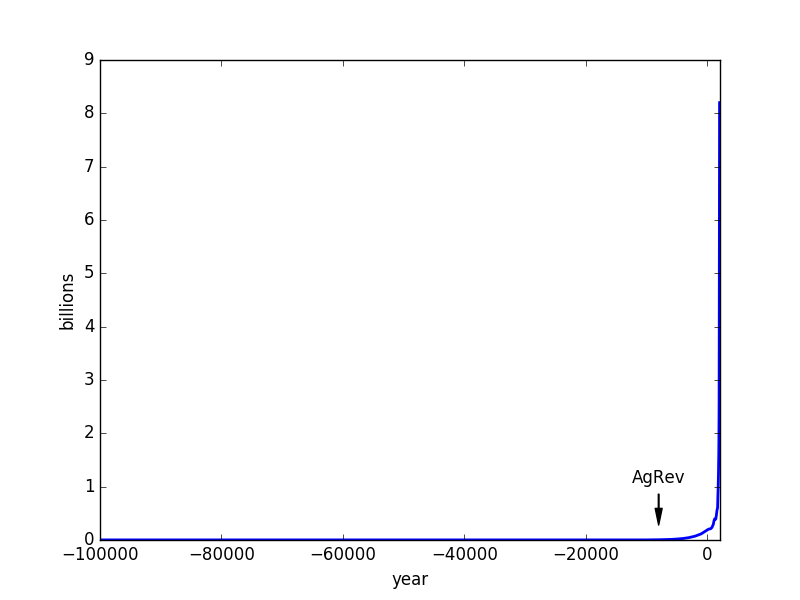
Some quibbling ensues about the choice of start date on the graph, but since the line does not begin at zero population, all is fine. For all this, Alan [still slow after 25 years!] fails to see how the graph is relevant to the question about our fate as a species.
Ishmael speculates that we are so inured to this shocking phenomenon that it fails to register as breathtaking and frightening. Had the plot applied to badgers, for instance, our eyeballs might pop out of their sockets: it would clearly indicate that something was seriously out of whack. Ishmael was disturbed by the degree to which Alan remained undisturbed.
The Sixth Mass Extinction
Injecting a bit of “future” knowledge into this passage, Ishmael speaks of Charles Atterley, known as “B” in Europe, who is going around the continent delivering underground lectures on related material to a dedicated following [see the “sequel” book The Story of B]. In a recent letter, Atterley updates Ishmael on the fact that biologists around the world are in agreement that a sixth mass extinction is underway. The exponential population graph has a mirror in extinctions, now transpiring at 1,000 times the natural rate: all down to humans.
Alan suggests that if elevated extinction rates are human-made, then perhaps they might be human-unmade. Perhaps, offers Ishmael, but this is impossible under the prevailing mindset. As long as we prioritize human well-being to the exclusion of the rest of the community of life, we make ourselves enemies of life. By increasing annual food production to “solve” hunger, we have surged to 8 billion in a few centuries. Without changing our mentality, we will not un-make the unfolding pattern of extinctions.
Quinn (via Ishmael) speculates that one billion humans might be indefinitely sustainable [I have my doubts]. In any case, a huge mental shift is needed if we are to deliberately pull back from the brink. It’s no small order: billions would have to change their mindset before the tide would turn.
Food Makes Babies, Again
Alan remains unconvinced about the formula that increased food production drives human population up [that such a crude biological relationship would apply to godly humans]. Ishmael counters that the dramatic rise in population deserves some explanation, and retools the argument.
First, Ishmael checks whether Alan agrees that if we have more people, we need to produce more food. “Certainly.”
Well, where did “more people” come from? How is it that population doubled in a mere 40 years? Such a biophysical anomaly demands a biophysical explanation. Death didn’t “take a holiday.” Did the surge come out of nowhere? Was it utterly spontaneous? [And what do we make of its perfect coincidence with mechanized agriculture and fossil fuels (the Green Revolution)?]
Ishmael points to Peter Farb and Thomas Malthus regarding the food–population connection. Malthus recognized the incompatibility of exponential population growth and finite (linear) agricultural potential. He also wondered how it is that more mouths appear, needing to be fed. He noted that increased food capacity enabled population growth.
Changing Mentality
If humans are to un-make the metacrisis, it must start with a change of mentality: a refusal to answer population growth with more food in an endless positive feedback loop [positive feedback leads to exponential runaway: not a “good” feedback, despite the positive “vibe” of “positive.”]
Alan asks: Won’t this refusal lead to worldwide famine and starvation? Ishmael: Why should it? Holding food production steady provides enough food for the current population. The madness has to stop, somehow.
But could we even hold steady at current rates? Would that reverse the damages and defuse the sixth mass extinction? Ishmael admits that: no, it’s not enough. But halting growth is a crucially-important first step. Dialing down necessarily involves the cessation of going up.
The Hard Descent
So, what follows this first step of halting growth? Ishmael acknowledges that stopping growth is easy compared to the next part. Temporary as they must be, the “gains” of modernity continue to coddle us if we only halt growth. It is the path down that will take a heavy toll—perhaps unpleasant enough to make extinction seem preferable.
Quinn again speculates that one billion humans might be maintained indefinitely, but correctly notes that we need not set a target in advance. If we find that one billion is still too much, we continue the downward glideslope. The process would take a century or two—becoming normal/routine, and even instinctive. Only by accepting this transition will we earn our moniker of Homo sapiens.
Alan, in a decent capture of how many react to such propositions, erupts in indignation over the prospect of purposeful population descent:
What ‘process’ are you talking about? Wholesale genocide? Everyday extermination of female infants? Genetically-engineered epidemics spread globally? Do you think we’re capable of atrocities like that?
Ishmael’s reaction is similar to my own: don’t be absurd. [It’s an unnecessary but perfectly predictable tantrum, in reaction to the offensive suggestion that humans face limits and are not entitled to anything we wish.] Ishmael observes that if a newspaper suggested ending the sixth mass extinction by attending to human population and shepherding it to lower numbers, the comments section would blow up with manufactured and hyperbolic atrocities of every flavor. The prospect strikes a deep nerve, which is revealing.
[As I believe we are likely to witness this century, global population can go down by demographic dynamics alone—influenced by a growing host of negative feedback factors that are causing fertility rates to plummet: no one need die of “atrocity.” Every person has no choice but to die, eventually, as an absolute certainty. Bringing new humans into the world is not comparably certain, and this flexibility alone is capable of a surprisingly quick population descent. See my video and related posts.]
Invent
Ishmael clarifies that he suggests no such program of atrocity [see note above]. But, Alan wonders, what is Ishmael proposing?
“You’re a tremendously inventive people, aren’t you? … Then invent.”
Alan is disappointed not to receive a packaged answer [Takers love their programs], but Ishmael points out that this whole process is meant to draw answers out of Alan, not plant them into a passive pupil.
Next Time
In the next installment, Chapter 10 turns into a novel again before Ishmael reluctantly resumes the lesson plan.
I thank Alex Leff for looking over a draft of this post and offering valuable comments and suggestions.



Comments
We changed commenting systems on September 10, 2026 as part of a site-wide functionality and security upgrade. Your past comments have not disappeared, and you can still log in with your old Disqus account credentials if you wish. Contact us with any questions.
The "demise of other species" in order to support dairy need not be the case.
That says more about our general state of overshoot more than it says about cattle.
In classic pastoralism, domestic cattle had little impact on wildlife. But we need to lose some 7/8th of our over-shot population to get back to that!