The philosopher Marcus Tullius Cicero introduced the Romans to the chief schools of Greek philosophy and was likely the most influential philosopher in ancient times but met his demise by getting too intimate with the politics of the period. He lived during the last days of the Roman Republic, in the latter half of the century before Christ. It was a time of power struggles, civil wars and the ascent and fall of Julius Caesar.
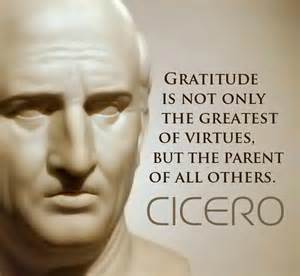 In the last book, Cicero describes what for him would seem a perfectly happy life, which includes both pursuit of virtue and external goods. At the end of the book, Cicero critiques the logical inconsistencies of his own conclusions, but not the broader principles, and says that while he has reservations, he designs his own life around these prescriptions.
- All things start from small beginnings.
- Nature abhors a vacuum.
- No one wishes pain, but occasionally circumstances occur in which toil and pain can procure some greater good.
- ’Tis an excess of pleasure not to feel a trifle uneasy.
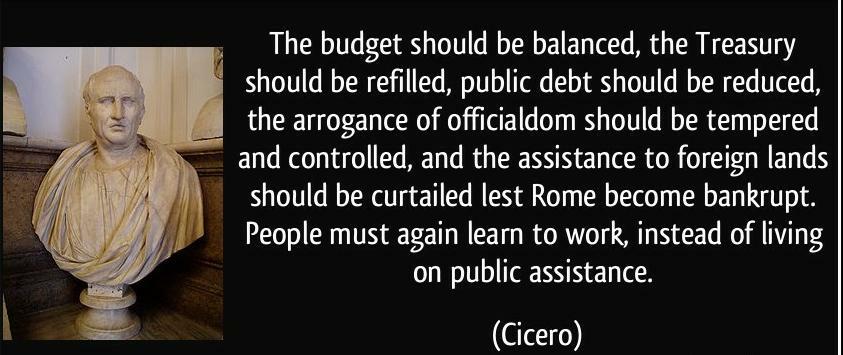
If increasing average national happiness is the goal of advanced capitalist societies and economies, then something seems to have gone awry. Whilst high income economies may have largely failed to date to decouple their economic growth from the most important measures of ecological footprint and impact, they have had more unwitting success in decoupling it from increasing the happiness of their populations. Various studies using both cross-national and within-country longitudinal data indicate that the correlation between happiness and per capita income or GDP seems to become weak or even disappear, at a level past about US $10,000 per year.—Martin Pullinger
 For the past two centuries as a fossil-fueled technological revolution rocketed industrial productivity, neither leisure time nor security of food, health and shelter increased for the broad masses of humanity. Instead of translating productivity gains into affluence for the many, including ecological health, growing and globalized population kept downward pressure on wages and job availability —bringing about the socially accepted meme of casino economies and affluence for the few. For the few, this created previously unimagined wealth. For the many, it augured diminished expectations for succeeding generations.
We are in a bind that can no longer be moderated by changing to or from a gold standard, or cryptocurrency, or using complicated debt stimulus. Production and consumption are equal evils. As we peer over the edge of the cliff we are about to dive from, we keep hearing ideas about steady state economies, circular economies, gift economies and the like. Some of these pay more attention to biophysical constraints than previous economic models did. But do they pencil out in the social sphere? Can they stick as memes? Is there enough time left to matter?
 Cicero agreed with Aristotle that humans are a kind of moral deity, and fulfillment in life comes from meeting the ends “whereunto he is born, (through) observation and action, as a horse to racing, or an ox to ploughing….” (translation by Jeremy Collier)
Eleven years ago, in The Post-Petroleum Guide and Cookbook: Recipes for Changing Times, we began our now-seemingly relentless theme:
The principal challenge of the Great Change is not physical but mental (as it is in any survival situation). Collectively, societies that are heavily addicted to consumer goods and the pattern of waste that a consumer culture creates will have to struggle to adjust to a new normal. It will not be optional and neither money nor social position will allow you to escape.
The easy path is to downsize expectations and simplify your lifestyle. This path requires giving up certain ways of looking at the world in order to embrace other, more survival-oriented ways. The hard path is to try not to make this change, to somehow cling to the old ways as long as possible, which will entail huge — I would say cruel — efforts for diminishing yields.
- Walking instead of driving
- Giving children more free time
- Reading instead of watching television
- Eating home-cooked meals with family and friends
- Taking up relaxing hobbies such as painting, gardening, or knitting
- Practicing yoga, tai chi, or meditation
- Unplugging from technology
- Indulging in leisurely love-making
- Simply resisting the urge to hurry unnecessarily
The presence of the clock gave birth to the notion that time lies outside our bodies — that it can be tracked by a machine, and that we can sit and watch it “fly” by, tick-tock, as though it is something linear, containable, and separate from the organic, flowing process of life.— Jose Arguelles, 2005
 You can go rent a good surfer movie like Waveriders, Blue Crush or Step into Liquid and it lays out a sensibility of timelessness. When the waves aren’t running high enough, hard core surfers work, building boards or flipping burritos. Otherwise, “productivity” is measured by how close one can come to a perfect ride.
 In Metamorphosis, the Roman poet Ovid, born nine months before Cicero’s murder, retold the Greek’s story of Icarus who took flight on wax wings made by his father, Daedalus. When Icarus ignores his father’s warning not to fly too high, the sun melts the wax, and Icarus falls into the water and drowns. Like Icarus, our parents fashioned wings from fossil fuels and a few among them even warned us not to fly too high, lest we upset the thin atmosphere that shields us from the sun.