



Citing Health Risks, Cuomo Bans Fracking in New York State
Thomas Kaplan, New York Times
Gov. Andrew M. Cuomo’s administration announced on Wednesday that it would ban hydraulic fracturing in New York State because of concerns over health risks, ending years of debate over a method of extracting natural gas.
Fracking, as it is known, was heavily promoted as a source of economic revival for depressed communities along New York’s border with Pennsylvania, and Mr. Cuomo had once been poised to embrace it…
Nature fires back at EIA shale gas critique
Daniel J. Graeber, UPI
The journal Nature stands by the accuracy of a feature questioning the longevity of the growth in U.S. shale natural gas, the features editor said Thursday.
The U.S. Energy Information Administration took issue this week with an article published by Nature, in which Texas researchers said a detailed analysis of U.S. shale plays may be "bad news" for forecasters.
In a Dec. 15 retort, EIA countered the Nature article was filled with "inaccurate and distorting reporting." It further questioned Patzek’s role in the research supporting the article, saying he had only a limited role in the actual studies…
America is Shaking its Addiction to Oil
Jeremy Scott Diamond, Lynn Doan, David Marino, Dan Murtagh, Bloomberg
With so much cheap oil available you’d expect consumption to be soaring – yet that isn’t happening…
Graphic presentation of the data
To Curb Climate Change, China Slows Coal to Gas
Coco Liu and ClimateWire, Scientific American
China will exclude additional coal-to-natural-gas projects from its coal industry’s next five-year development plan, according to local media reports.
China Energy News, a state-run newspaper, cited a policymaker Monday as saying that China will complete the construction of approved coal-to-natural-gas plants but will not approve new projects until 2020, aiming to keep its coal-based synthetic natural gas production capacity to 15 billion cubic meters at the end of the decade…
Catholic Bishops From Every Continent Call For ‘An End To The Fossil Fuel Era’
Jeff Spross, Climate Progress
A group of Catholic Bishops called on the world’s governments to end fossil fuel use on Wednesday, citing climate change’s threat to the global poor as the lodestar of their concern.
According to the BBC, the statement is the first time senior officials in the Church from every continent have issued such a call. The statement also drops in the middle of ongoing international climate talks in Lima, Peru, as countries continue to hash out what to do about climate change in the run-up to a summit in 2015, where observers and activists hope a new international agreement will be finalized…
Is It Bad Enough Yet?
Mark Bittman, New York Times
THE police killing unarmed civilians. Horrifying income inequality. Rotting infrastructure and an unsafe “safety net.” An inability to respond to climate, public health and environmental threats. A food system that causes disease. An occasionally dysfunctional and even cruel government. A sizable segment of the population excluded from work and subject to near-random incarceration.
You get it: This is the United States, which, with the incoming Congress, might actually get worse.
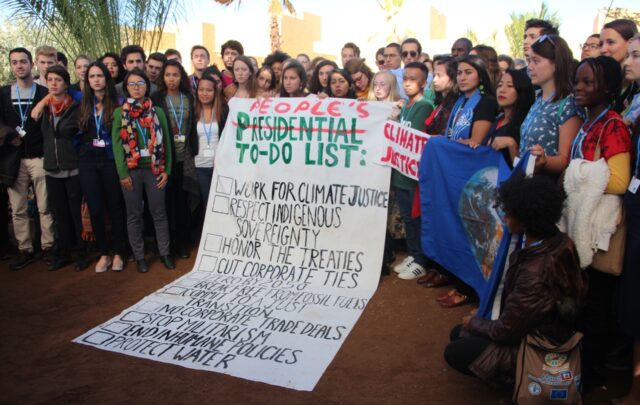
This in part explains why we’re seeing spontaneous protests nationwide, protests that, in their scale, racial diversity, anger and largely nonviolent nature, are unusual if not unique. I was in four cities recently — New York, Washington, Berkeley and Oakland — and there were actions every night in each of them. Meanwhile, workers walked off the job in 190 cities on Dec. 4.
What makes this an exciting time is that we are beginning to see links among issues that we have overlooked for far too long…
Earth faces sixth ‘great extinction’ with 41% of amphibians set to go the way of the dodo
Robin McKie, The Guardian
A stark depiction of the threat hanging over the world’s mammals, reptiles, amphibians and other life forms has been published by the prestigious scientific journal, Nature. A special analysis carried out by the journal indicates that a staggering 41% of all amphibians on the planet now face extinction while 26% of mammal species and 13% of birds are similarly threatened.
Many species are already critically endangered and close to extinction, including the Sumatran elephant, Amur leopard and mountain gorilla. But also in danger of vanishing from the wild, it now appears, are animals that are currently rated as merely being endangered: bonobos, bluefin tuna and loggerhead turtles, for example…
Electric Cars a Mixed Bag For Health, Climate
Bobby Magill, Climate Central
Plug a new electric Nissan Leaf into a charging station, and it’s easy to feel good that the vehicle’s environmental and climate impacts may be small compared to all the cars on the road running on gasoline.
But driving an electric car could be worse for both the climate and public health if the electricity that runs it was generated at a coal-fired power plant. If that electricity came from solar or wind generators, then an electric vehicle is among the cleanest forms of transportation around.
In fact, the environmental and human health costs of operating an electric vehicle using electricity generated from coal may be as much as 80 percent greater than driving a gasoline-powered vehicle, according to the study, conducted by a team of researchers at the University of Minnesota and published Monday in the Proceedings of the National Academy of Sciences…
Why aren’t climate models better at predicting Arctic sea ice loss?
Roz Pidcock, Carbon Brief
Climate models generally do a poor job of capturing how rising temperatures in the Arctic are affecting sea ice. Most underestimate the rapid pace at which sea ice is diminishing.
Why is that?
Scientists at the massive science conference hosted by the American Geophysical Union (AGU) taking place now in San Francisco have been discussing why it is so difficult to capture what’s happening to Arctic sea ice in climate models, and how we can make the most reliable forecasts possible with the tools available…




Comments