Click on the headline (link) for the full text.
Many more articles are available through the Energy Bulletin homepage
UVic bans plastic utensils, uses bamboo instead
Judith Lavoie, Times Colonist (Canada)
Compostable bamboo knives, forks, spoons now the norm
—
Plastic is passe if you’re picking up a meal at any of the University of Victoria’s 10 food outlets.
Instead of the hard, white plastic utensils usually dished out with take-away meals, UVic’s cafeterias are handing out smooth, brown cutlery made of bamboo.
“It’s 100 per cent compostable,” said Lisa Church, UVic co-ordinator of retail outlets, proudly showing how the serrated edge is strong enough to cut steak.
… The bamboo utensils were tested in one of the cafeterias and response was so positive that it has been expanded to all the food outlets.
“It has got a very distinct look and feel. Our customers loved it,” said sustainability co-ordinator Sarah Webb.
(17 February 2009)
A master backpacker once surprised me by saying that he only took chopsticks on his treks. “The Chinese are an old culture,” he pointed out. “They’ve developed super-efficient ways of doing things – like chopsticks.” -BA
How to Start a Farm with No Land and Little Money
Jason Bradford, The Oil Drum: Campfire
I originally wrote the story below for the magazine Touch the Soil. Not everybody who worries about food security and is interested in doing something about it has access to plenty of land or money to buy land and necessary equipment. I was in this situation a few years ago and rather frustrated by it. Perhaps this story will give others some ideas, and I should note that Touch the Soil is a great source of information about the food system and efforts to transform it at all levels.
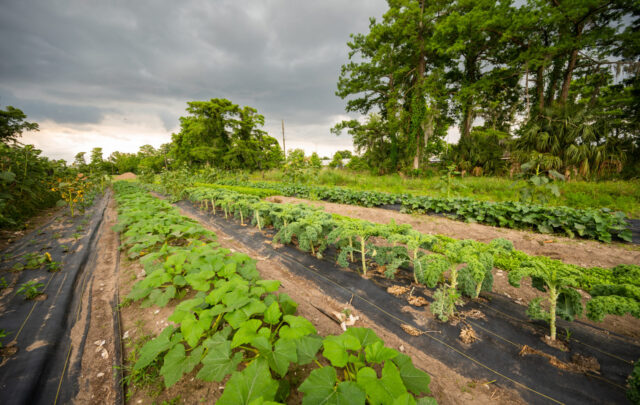
… The substitution of fossil fuels for labor in agriculture has created an abundance of cheap food and a dearth of farmers. Part of my struggle at Brookside Farm is employing more labor intensive, but ultimately more sustainable, practices while still keeping the food in line with price expectations. So far this has meant that CSA share sales are less than the cost of production, with the difference made up by grants, donations, and a lot of volunteer labor. With the new photovoltaic system I will begin using more time saving tools that can run on renewably generated electricity, but many of these are capital intensive.
As a new farmer of course I have learned a great deal about the predilections of various crops and their pests. But what interests me more to consider is how my character has changed. As a farmer I am viscerally aware of my dependence upon forces beyond my control and at great scale. I now face the world with greater humility. When I plant a seed or a tree, I know that it will take time to bear fruit and this imbues me with greater patience. My body is required to get up and work day after day, and because I have a responsibility towards the farm I must maintain my health. Therefore, I have learned to work at a pace that is steady and earnest, not quick and exhausting. And although each winter I make plans about how the season will unfold and what my schedule will be, no year is average and I have learned to deviate from my path when appropriate, knowing that survival requires adaptation to reality. These lessons are as good as anything I learned while still in school.
(18 February 2009)
Bantry CSA – the Community Solution to Getting Your Oats?
Ivan McCutcheon , Food Culture West Cork
I have been interested for some time in a model of food production called Community Supported Agriculture (CSA) so I was delighted to find that a few pioneering souls are getting one going on the Sheep’s Head. Community supported agriculture is a relatively new socio-economic model of food production, sales, and distribution aimed at both reducing the financial risks for the producers and increasing the quality of food and the care given to the land. It is also a method for small scale commercial farmers and gardeners to have a successful, closed market.
…. Bantry CSA will produce its first harvest later this year and as far as I can gather, it is the first of its kind in Ireland. I travelled down to Gerahies on the Sheep’s Head to meet John Dolan, the CSA founder and co-ordinator and Charlie Donovan, one of the three farmers involved in the scheme. John explains his motivation for getting the CSA scheme going:
“Lisa and I have for the most part taken control of our own food supply, if we’re not growing it ourselves then at least we know where it comes from. But we don’t have enough land to grow our staples, particularly cereals. Many of my friends are in a similar situation, so we were looking at ways of sourcing more directly. I had heard about CSAs and thought there was no reason they’d have to be just fruit and veg box schemes. They could be field crops too. So I started talking to my friend Charlie Donovan to see what he thought of the idea.”
… Despite our still cherished Celtic tiger notions of upperocity, I think that most of us have a sense that farming is good work. We hold close the notion of a meitheal or community gathering for collective work which is built on passed down memories of farm work that brought people together, such as at harvest time and threshing. Many CSAs draw people into aspects of the work on farm. One of the big challenges for Bantry CSA will be to develop the infrastructure locally for processing oats, which need to be dried, dehusked and rolled before they land steaming on the breakfast table.
(11 February 2009)
Suggested by EB contributor Graham Strouts.
It Starts at Home
Peter Miller, National Geographic
Not long ago, my wife, PJ, and I tried a new diet—not to lose a little weight but to answer a nagging question about climate change. Scientists have reported recently that the world is heating up even faster than predicted only a few years ago, and that the consequences could be severe if we don’t keep reducing emissions of carbon dioxide and other greenhouse gases that are trapping heat in our atmosphere. But what can we do about it as individuals? And as emissions from China, India, and other developing nations skyrocket, will our efforts really make any difference?
We decided to try an experiment. For one month we tracked our personal emissions of carbon dioxide (CO2) as if we were counting calories. We wanted to see how much we could cut back, so we put ourselves on a strict diet. The average U.S. household produces about 150 pounds of CO2 a day by doing commonplace things like turning on air-conditioning or driving cars. That’s more than twice the European average and almost five times the global average, mostly because Americans drive more and have bigger houses. But how much should we try to reduce?
For an answer, I checked with Tim Flannery, author of The Weather Makers: How Man Is Changing the Climate and What It Means for Life on Earth. In his book, he’d challenged readers to make deep cuts in personal emissions to keep the world from reaching critical tipping points, such as the melting of the ice sheets in Greenland or West Antarctica. “To stay below that threshold, we need to reduce CO2 emissions by 80 percent,” he said.
“That sounds like a lot,” PJ said. “Can we really do that?”
It seemed unlikely to me too. Still, the point was to answer a simple question: How close could we come to a lifestyle the planet could handle? If it turned out we couldn’t do it, perhaps we could at least identify places where the diet pinched and figure out ways to adjust. So we agreed to shoot for 80 percent less than the U.S. average, which equated to a daily diet of only 30 pounds of CO2. Then we set out to find a few neighbors to join us.
John and Kyoko Bauer were logical candidates. Dedicated greenies, they were already committed to a low-impact lifestyle. One car, one TV, no meat except fish. As parents of three-year-old twins, they were also worried about the future. “Absolutely, sign us up,” John said.
(March 2009)