


Click on the headline (link) for the full text.
Many more articles are available through the Energy Bulletinhomepage
Artists reimagine poster art of the Great Depression (text and PDFs)
Steven Heller, ReadyMade
Poster Children
ReadyMade asks five artists to reimagine the populist poster art of the first Great Depression Introduction by Steven Heller
—
“State-sponsored art” conjures the specter of menacing regimes and authoritarian leaders imposing turgid styles on “official artists.” Conform or else! But 75 years ago, when President Franklin D. Roosevelt launched his plan for national recovery with the founding of the New Deal, under whose auspices the Works Progress Administration (WPA) oversaw the Federal Art Project (FAP), state sponsorship was not a dictatorial command but a generous invitation for artists of all stripes to take part in the moral rejuvenation of a United States besieged by economic calamity—or what Jon Stewart dubs “the first Great Depression.”
American art has never been so liberally supported by government as it was during the critical years between 1933 and 1943. The FAP served a dual purpose: It gave unemployed artists work while demonstratively branding the virtues of the nation through rousing mass communication. ….
SIMPLICITY IS THE KEY TO SUCCESSFUL LIVING
by Nick Dewar
“I hope that America is entering a post-’greed is good’ period. I can’t think of a single step that would change the nature of our society more than everyone abandoning their automobiles and cycling instead. There would be less dependence on oil, obesity levels would drop dramatically, and reflective bike clips would replace fancy ladies’ purses as the current must-have fashion accessory.”
{see more of Nick’s work at nickdewar.com}
LET THEM GROW
by Mike Perry
“I really responded to the original WPA phrase ‘let it grow’—it seemed much bigger. I wanted to make something that lifted spirits. It seems like the program should have never stopped. I know so many brilliant artists who could have used some government funding even while the economy was booming.”
{see more of Mike’s work at midwestisbest.com}
EAT LOCAL, BUY LOCAL, GROW LOCAL!
by Christopher Silas Neal
“Solving the world’s energy and food problems would do a great deal to strengthen the global economy, prevent disease, and reverse the effects of climate change. The original Victory Garden program was designed to ease pressure on the public agricultural supply and support the war effort by encouraging families to grow their own food. I wanted to expand this idea to the broader concept of buying and eating local food.” …
(December 2008)
An edible Statehouse lawn? Vermont group looks at life without oil
Thatcher Moats, Barre Montpelier Times Argus
MONTPELIER – The times they are a-changin’, and some area residents plan to be ready for them.
About 70 people gathered at a meeting of the group Transition Town Montpelier at the Unitarian Church on Saturday to explore the steps they can take to make the adjustment from a society based on cheap petroleum to one where food, energy and currency systems are more localized.
Transition Town Montpelier is the sixth Transition group founded in the United States, according to the group’s Web site, and just the second on the East coast.
Transitions groups have formed in response to the notion of “peak oil,” the point at which the maximum rate of global petroleum extraction has been reached, after which the rate of oil production enters terminal decline.
Without cheap oil, the thinking goes, most of the systems that modern society relies on simply won’t work.
So what systems do we replace them with? Well, that’s what Saturday’s meeting was all about.
After an introduction, the large group of attendees broke down into smaller groups.
One group talked about food systems. Other groups examined different forms of currency, different ways to produce and conserve energy, and the psychology of the transition.
… For more information go to www.transitionvermont.ning.com
(11 January 2009)
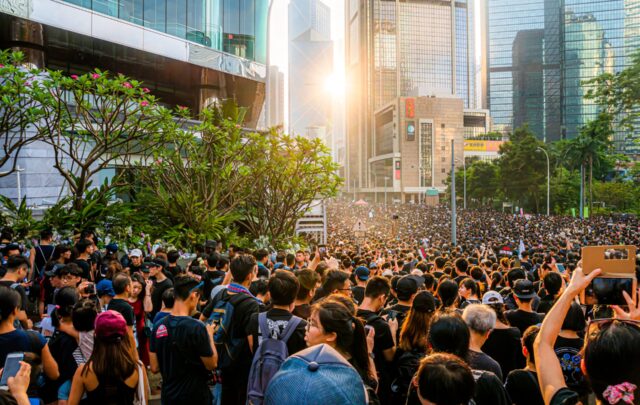
Classic photo at original epitomizes the struggle to express concern. -BA
EB contributor Carl Etnier writes:
It was a nice-sized crowd for a sunny Saturday. I was pleased to see the paper cover it, too, with both a photographer and reporter; it’s typically difficult to get reporters to Saturday events here.
In New York, No Crisis for Niche Manufacturers
Christine Haughney, New York Times
The workshop where John Randall assembles $3,000 pine-beam tables is so cramped that he holds client meetings at a sawdust-covered worktable and has to shuffle his equipment around to make elbow room for himself and a co-worker.
But the recession notwithstanding, he has enough orders to keep busy through April and hopes to buy a $2,000 drill press and hire another full-time woodworker soon. So Mr. Randall recently signed a lease to double his space at the Brooklyn Navy Yard.
“It doesn’t feel like a slowdown,” he said. “We all may not have any work in three months. But we’ve been saying that for three months.”
Mr. Randall’s three-man company, Bien Hecho, may be one of the brighter lights in the city’s darkening economy. For more than 50 years, large-scale manufacturing in New York has been shrinking as textile factories, printing plants and sugar refineries have shut down or moved south and overseas.
But in recent years, small manufacturers like Bien Hecho (Spanish for “well made”) have been on the rise, making products for niche markets and wealthy customers. And now, even as the broader economy is suffering, many of those manufacturers are proving surprisingly resilient, city officials and economic analysts say.
Some businesses are making products that government agencies and companies are still buying, like body armor for soldiers in Iraq and sets for television programs like “Saturday Night Live.” They also make food products like tortillas for local immigrant communities and baguettes for Manhattan restaurants. Others make luxury goods, like high-end audio speakers, that affluent customers are still buying.
(10 January 2009)
EB contributor Carl Etnier writes:
Body armor for Navy SEALs, $3,000 tables, $6,000 stereo speakers: these are not the things we think of as the backbone of a sustainable, local economy. It’s ironic that manufacturing these luxury items is increasingly profitable while millions in this country alone are losing their jobs, and many don’t have enough to eat. (I expect the body armor doesn’t seem a luxury to the SEAL wearing it, but the wars he’s fighting were an optional luxury for the US.)
On the other hand, the small-scale, urban manufacturers who are making these things now are preserving and expanding the infrastructure, skill sets, and the business networks that can provide for more basic needs as the global supply networks break down.
UPDATE (Jan 12, 2009)
EB reader Shaun Chittick comments:
Having worn body armor as a SEAL off and on for the past 23 years, I can tell you it is absolutely NOT a luxury–it’s a necessity for survival on most of the missions we have performed since 9/11. Body armor is hardly exclusive to SEALs–it is essential equipment for every fighting man, woman, many contractors and even some reporters in either Iraq or Afghanistan. It is outrageous to even put the words “body armor” and “luxury” in the same sentence! Luxuries like body armor make the inconvenience of enemy bullets much more tolerable.
EB reader Tom Deam comments:
How is body armor a luxury for SEALs? Yes this is an editorial, but it does not speak the truth.
Happiness grows out of tiny parks, not huge TVs
Erik Reece, Lexington Herald-Leader
Of all the strange, inspiring and disturbing headlines of 2008, my mind keeps returning, for some reason, to a short piece of reportage buried at the bottom of the New York Times editorial page last summer.
According to “Life in a Slow Lane,” there is now such a dearth of green space in New York City, residents have taken to rolling out Astroturf in curb-side parking spaces, plopping down lawn chairs, and feeding quarters into the meter all day in exchange for this makeshift.
So bad is it, Mayor Michael Bloomberg decreed that Manhattan needed “wedge parks,” little triangulations of grass and planters squeezed like green anvils into the traffic along Broadway and Madison Square. Apparently, New Yorkers are flocking to these verdant patches.
According to the Times, the wedge parks offer “incalculable value in providing a place to comfortably make a cell phone call, to finish a coffee or to reorient before heading back into the fray.”
But aside from these rather slight and dubious virtues, the success of the little parks reveals something more telling. We, as a species, have drifted too far from our ancestral environment, and are finally yearning for a return — however perversely that yearning becomes manifest.
I’m not saying we secretly want to trade plasma screens for campfires and go charging back into the Pleistocene. But it is true that 500,000 years ago we became the species Homo sapien, and for the next 480,000 years we lived in small, tightly knit communities that depended on cooperation for survival and never made a tool of war.
That is to say, for roughly 96 percent of our evolutionary lives, we lived very close to the patterns and cycles of the natural world.
(11 January 2009)




Comments
We changed commenting systems on September 10, 2026 as part of a site-wide functionality and security upgrade. Your past comments have not disappeared, and you can still log in with your old Disqus account credentials if you wish. Contact us with any questions.