


Click on the headline (link) for the full text.
Many more articles are available through the Energy Bulletin homepage
Transition Towns movement hits “The Archers”, UK cultural intitution
The Archers, Radio 4 (transcript via email)
Pat Archer introduces Kathy Perks to the idea of introducing a ‘transition’ initiative in Ambridge.
PA: It’s something the Soil Association has been talking about for a long time. Transition is a way of actually making a difference. It’s not just about food.
KP: You mean you want everyone to eat local produce or grow their own?
PA: The Transition Movement says we’ve got to do something about climate change and we’ve got to reduce our dependency on oil.
KP: Everyone says we’ve been doing that for ages
PA: Well Transition communities are actually doing it how in lots of ways .. energy descent plans, community orchards, woodchip boilers, economic localisation, the Totnes pound …
KP: The what?
PA: You know, Totnes in Devon, they’ve created their own currency which you can only use locally.
KP: Good grief – all sounds pretty ambitious.
PA: Well it’s got to be.
KP: And you’re expecting the whole of Ambridge to get involved?
PA: Definitely the whole of Ambridge and other villages. Most of the places doing it are Transition Towns. There are a few villages.
KP: Well you can see why if you’re asking people to get out of their cars ….
PA: In Stroud they’re setting up a community bike scheme ….
KP: It sounds amazing – still think you’ll have a job selling it to the whole village.
PA: Well I’m going to carry on with it and see how far I can get.
(24 March 2008)
“The Archers” is a cultural institution in Britain. As Wikipedia says:
The Archers is a British radio soap opera broadcast on the BBC’s main speech (as opposed to music) channel, Radio 4. It is the world’s longest running radio soap with more than 15,000 episodes broadcast.
Urban jungle
Catherine Early, The Guardian
As food prices soar, could a project that saw fruit and vegetables grown in town-centre planters and parks be a blueprint for the future?
—
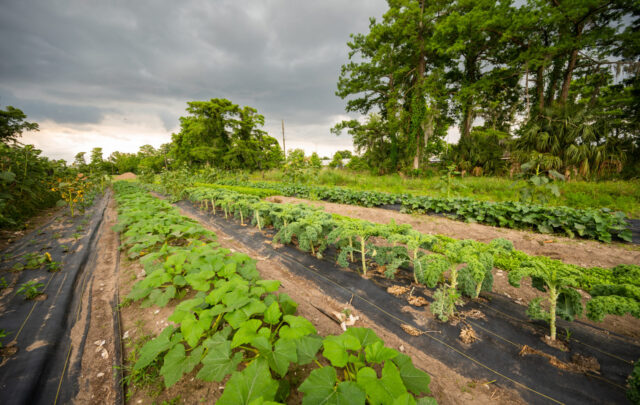
People visiting Middlesbrough last year may have wondered why there were radishes and pumpkins being grown where they might have expected to see carnations and dahlias. All over the town, disused urban spaces were turned into fertile corners bursting with freshly grown fruit and vegetables as more than 1,000 residents took part in a project aimed at changing the way they think about food. This year, the results could be even more spectacular.
The idea of the urban farming project was to make people more aware of food miles, improve health and aid regeneration of the borough, which contains the ninth most deprived area in the UK. Groundwork South Tees advised schools, mental health hospitals, residential care homes and retailers on planting and growing many varieties of herbs, vegetables and fruit. Containers of different sizes were used so people could cultivate whatever space they had.
Middlesbrough borough council turned over parkland, town-centre planters and other landholdings for fruit and vegetable growing. The eight-month project culminated in a town meal outside the Middlesbrough Institute of Modern Art, where up to 8,000 people shared meals from the food that had been grown.
… The Middlesbrough project may set an important example to other towns if rampant food inflation continues unabated. The past year has seen riots and food shortages in countries including Mexico, Italy and India, with the UN last month noting problems in urban areas that have previously been immune from food insecurity.
A lack of food may seem unthinkable in the UK, where supermarket shelves groan under the variety on offer. But the Office for National Statistics last month reported the highest ever recorded rise in the price of food. The cost of vegetables, for example, has risen by more than 6% in 12 months.
Tim Lang, professor of food policy at City University, says the era of cheap food in the UK is over, and that the nation is “sleepwalking into a crisis”. He points out that the UK has an especially poor record on producing its own fruit and vegetables. “Ninety-five per cent of fresh fruit is imported. This is ludicrous in a country with 2,000 varieties of apples,” he says.
(26 March 2008)
Green Dragon film producer discusses China’s green building movement
Monica Trauzzi, E&E TV
As China gears up to host this year’s Olympics and the international community tries to engage this developing nation to reduce emissions, steps are being taken by the national and local governments in China to create a more sustainable society.
During today’s OnPoint, Caroline Harrison, creative director and co-producer of The Green Dragon media project and film, discusses her experiences filming her new documentary that focuses on the sustainable design movement in China. She addresses public reaction to the movement and discusses the expert interviews she conducted while in China. She also talks about some of the major challenges facing the Chinese as they try to create a more sustainable environment.
(26 March 2008)
Good interview, sympathetic to the Chinese struggle. Much more than about green building. Video clips and more info at Green Dragon Media Project.
KunstlerCast #6: Zoning (audio)
James Howard Kunstler via Global Public Media
Ya seen one town in America, ya seen ’em all. But that’s because they’re all mandated to look that way! In this episode of KunstlerCast, James Howard Kunstler tells the tragic story of zoning codes in the United States. At one time, zoning was a rational response to unpleasant conditions of the newly emerging industrial city. But the fanatical level to which zoning became worshiped by public officials has reduced urban planning from an art form to the mere administration of curb cuts, signage and statistical analysis of traffic flow.
(20 March 2008)
KunstlerCast #5: Starchitects (audio)
James Howard Kunstler via Global Public Media
How and why did Seattle build that hideous new public library? asks one listener from that city. In this episode of KunstlerCast, James Howard Kunstler tells us how cities get hoodwinked into a status fashion contest to have a museum or library built by one of the celebrity architects of the day. Rem Koolhass, Frank Gehry, Peter Eisenman and others are deliberately designing these disastrous, anxiety-inducing mothership UFOs in order to mystify people into thinking they’re supernaturally brilliant. And then we’re stuck with these Gillette Blue Blade-clad fun houses for decades.
(13 March 2008)


Comments
Welcome to the new Resillience commenting system!
We have moved from the former Disqus commenting system to a new system as of September 10, 2026.
We made this change because of privacy concerns regarding Disqus. It's also part of a set of changes to bring more services to the Resilience community under a single login: commenting, (coming September 2026), and online courses (coming 2027). Unfortunately, your old Disqus comments may not reliably link to your account in this new system. Please contact us if you have any questions or concerns.